Languages
Search
Newswire on the IFIs
- The toxic legacy of the Greek crisis
- Ending poverty: Lying with statistics
- Greek bailout: 77 per cent went into the financial sector
- How the World Bank could slash its carbon emissions: Start flying in coach
- "Carbon farming" makes waves at stalled Bonn talks
- Dancing on hot sand: Egypt and the IMF loan
Innovative Mechanisms for financing development
Robin Hood Tax: Canada misses a chance for Leadership
OTTAWA – The Canadian Government is missing an historic opportunity to offer constructive global leadership by refusing to consider any kind of levy on the global financial sector.
“There are two proposals on the table here,” said Fraser Reilly-King of the Halifax Initiative. “One would save the banks, the other would save the world. At a time when global poverty is rising, along with sea levels, and European economies are crashing, the Harper government is actively campaigning against both.”
A Bank Tax would apply broadly and ensure future bailout funds would come from banks themselves, not the public. Canada’s counterproposal involves “embedded contingent capital,” which would shift the burden to shareholders, turning [contingent] bonds to equity if the banks run into trouble.
Innovative mechanisms for financing development, and in particular the Financial Transactions Tax
by Fraser Reilly-King, Coordinator, Halifax Initiative Coalition
May 6, 2010
My name is Fraser Reilly-King and I am the Coordinator of the Halifax Initiative, a coalition of eighteen development, environment, faith-based, human rights and labour organizations. We focus on international finance issues, in particular with respect to the World Bank, International Monetary Fund and export credit agencies.
IMF, European Union look to bail out Greece
Greece’s debt crisis is finally coming to a head, with International Monetary Fund (IMF) loans to deal with the country’s deficit and heavy debt load being hammered out in Athens. The European Union and the IMF are negotiating the terms of a bailout as fears mount that Greece’s crisis could soon spread to other countries in Europe and beyond. Other nations carrying significant debt loads, including the United States, are concerned that the Greek crisis is a harbinger of things to come, closer to home.
2010 G8/G20 Canadian Civil Society Coordinating Committee
Parliamentary Roundtables on the G8/G20 Agendas
Roundtable 3: The Millennium Development Goals
Tuesday, April 27th, 2010 9:00 am - 11:00 am Room 2-2, National Press Building, 165 Sparks Street, Ottawa
You are missing some Flash content that should appear here! Perhaps your browser cannot display it, or maybe it did not initialize correctly.
Climate Change and Poverty: Off the Table?
In the wake of the financial crisis, countries around the world have cut back on their commitments to combat climate change and poverty. As the G8/G20 leaders prepare to gather in June, what are the challenges and opportunities for getting these issues back on the table?
Presenters:
Charles Abugre, Director of Campaigns for the Millennium Development Goals, United Nations Development Program
Gauri Sreenivasan, Policy Coordinator, Canadian Council for International Co-operation
Wednesday, April 28th 7:00pm - 9:00pm
The University of Ottawa - Pavillion Desmarais
55 Laurier East, Room 1120 (First Floor)
For more information please contact Caroline Foster at cfoster@kairoscanada.org
Co-sponsored by:
Canadian Council for International Co-operation - Africa Canada Forum
Halifax Initiative
KAIROS: Canadian Ecumenical Justice Initiatives
School of International Development and Global Studies
Introduction
A growing number of politicians, civil society organizations, economists and some financiers have become strong advocates of a global Financial Transactions Tax (FTT). An FTT is a tiny tax on financial market transactions such as equity, bond, derivative or foreign exchange trades.
Political leaders, including the presidents of France and Germany and the prime minister of Britain, back an FTT as one of the best ways to fund programs to fight world poverty, pay for climate mitigation and adaptation costs and make financial institutions pay their fair share of the costs of the global crisis which, in large part, was created by their practices. Prominent economists advocate a Financial Transactions Tax as one way to cool down excessive speculation in financial markets, a principal cause of the economic crisis.
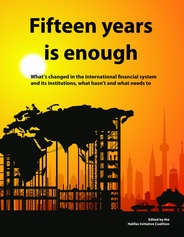
What’s changed in the international financial system and its institutions, what hasn’t and what needs to
Executive Summary
Back in 1995, the G7 met in Halifax during a “time of change and opportunity.” The meeting took place in a context of mounting deficits and debt crises in countries in the South; in the wake of economic collapse in Mexico; and amid strong global criticism from civil society, the media and governments about the World Bank and International Monetary Fund’s (IMF) austere neo-liberal structural adjustment policies.
A lot has changed since then, partly in response to the Halifax G7 Summit and subsequent G7 and G8 meetings. Too many of these improvements, however, exist only on paper. Beyond the surface, the neo-liberal, market-oriented bias that guides the Bank and Fund’s agenda and thinking has not altered.
The 2010 G8 Summit in Toronto in 2010 takes place during another “time of change and opportunity.” The financial crisis has spurred many civil society organizations (CSOs) to insist on far-reaching changes to the global financial system and its institutions. Clearly, as this publication will illustrate, 15 years of refusing to deal with the manifest shortcomings of the global economic system is enough.
Parliamentary Roundtables on the G8/G20 Agendas 2010 is an important and unique moment for Parliamentarians to engage with Canadians on some of the most important global issues facing our planet and our future. On June 25th, 2010, To date, there has been little discussion among parliamentarians about the themes leading up to the 2010 summits, and Canadian civil society is looking to engage members from all parties in a discussion around some of the issues highlighted in our civil society platform, An Agenda for Global Development: G8/G20 Civil Society Coalition Platform, endorsed by over 60 organizations across the country. The platform discusses specific, measurable, realistic recommendations to put poverty eradication, economic recovery for all and environmental justice at the centre of the international agenda. To facilitate the conversation, Canadian civil society is organizing three parliamentary roundtables to discuss party perspectives on climate change, the financial crisis and the millennium development goals (MDGs). The Roundtables will occur as the G20 Finance Ministers meet in Washington, as G8 Development Ministers meet in Halifax and as Canada hosts the Africa Partnership Forum in Toronto. Roundtable 1: Climate change Roundtable 2: Global financial crisis Roundtable 3: Millennium Development Goals |
ROUNDTABLE DETAILS Canadian G8 G20 Civil Society Platform Roundtable Agendas Moderator, MP and Expert Bios Podcasts
|
In "Alternatives", April 1, 2010
http://www.alterinter.org/article3457.html?lang=en
T-A-X. Such a simple three letter word, and yet it elicits responses from people out of all proportion to its size. Perhaps it isn’t surprising. Taxes are scary.
But let’s not forget, as much as you may hate them, without them, we wouldn’t have public health care, education, infrastructure, police and ambulances, government, politicians…(OK, maybe scratch that one). You get the idea. Boring and controversial as they are, taxes are essential.
Government accountability bill returns to the House
On March 3, the Governor General will open a new session of Parliament, ending the recess created when the Harper government prorogued the previous session in December. All legislation that was under consideration at that time was extinguished, with the exception of private members’ bills, which return to the House, unscathed. These bills begin anew at whichever stage of the legislative process they had reached before the plug was pulled on Parliament.