Languages
Search
Newswire on the IFIs
- Bangladesh exposes flaws in World Bank's Doing Business Index
- A flawed 'Doing Business' report
- Risk and accountability: What role for the Inspection Panel?
- Rio Tinto gets Australian government loan for Mongolian mine project
- Deutsche Bank and IFC accused of bankrolling Vietnam firms' land grabs
- World Bank data on measure of global poverty level faulted
Conditionality
|
Most Canadians would be surprised to learn that economists from the International Monetary Fund (IMF) annually visit Canada to dispense advice. We tend to think of the IMF as an institution that prescribes strong medicine, known as Structural Adjustment Programs (SAPs), only to less developed countries. In fact our governments regularly follow the same bitter prescriptions. |
![]() |
Final script May 22, 2010; release date June 18, 2010. |
You are missing some Flash content that should appear here! Perhaps your browser cannot display it, or maybe it did not initialize correctly.
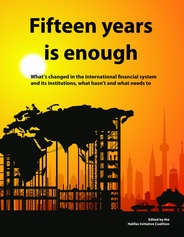
What’s changed in the international financial system and its institutions, what hasn’t and what needs to
Executive Summary
Back in 1995, the G7 met in Halifax during a “time of change and opportunity.” The meeting took place in a context of mounting deficits and debt crises in countries in the South; in the wake of economic collapse in Mexico; and amid strong global criticism from civil society, the media and governments about the World Bank and International Monetary Fund’s (IMF) austere neo-liberal structural adjustment policies.
A lot has changed since then, partly in response to the Halifax G7 Summit and subsequent G7 and G8 meetings. Too many of these improvements, however, exist only on paper. Beyond the surface, the neo-liberal, market-oriented bias that guides the Bank and Fund’s agenda and thinking has not altered.
The 2010 G8 Summit in Toronto in 2010 takes place during another “time of change and opportunity.” The financial crisis has spurred many civil society organizations (CSOs) to insist on far-reaching changes to the global financial system and its institutions. Clearly, as this publication will illustrate, 15 years of refusing to deal with the manifest shortcomings of the global economic system is enough.
Rethinking the international financial system during a time of crisis
Introduction
On October 19 and 20, 2009, the Halifax Initiative held a conference, co-hosted by The North South Institute, the University of Ottawa and the School of International Development and Global Studies (SIDGS), entitled "What’s Missing in the Response to the Global Financial Crisis?" The meeting brought together experts from a range of backgrounds to analyze the challenges facing the global economy, discuss the ways in which the international community has responded to the current financial crisis, and identify shortcomings in these responses.
CSOs push for Common Approaches revamp
Members of the Organisation for Economic Co-operation and Development (OECD) are currently reviewing a 2007 Council Recommendation regarding export credit agency (ECA) operations. The Recommendation on Common Approaches on the Environment and Officially Supported Export Credits (Common Approaches) is a “gentlemen’s agreement” that seeks to establish a level playing field regarding ECA environmental practice. CSOs argue that the Recommendation’s impact is undermined by the lack of effective accountability mechanisms to ensure consistent and effective application by member governments.
In June 2010, the Halifax Initiative launched the first in a series of radio documentary -type podcasts under the rubric of "Definitely NOT the G8" just ahead of the 2010 Group of Eight (G8) and Twenty (G20) meetings in Huntsville and Toronto, Canada on June 25-27 2010.
The podcasts have three goals:
- to raise awareness in Canada about progressive social, economic and environmental justice issues in the international development and finance arena that are often missing from, or disregarded in, official discussions and the mainstream media;
Governance and institution - Global economic governance in crisis: new players, new power
Moderator: Gordon Betcherman, Professor, School of International Development and Global Studies, University of Ottawa
You are missing some Flash content that should appear here! Perhaps your browser cannot display it, or maybe it did not initialize correctly.
Rules and policies - Raising and retaining funds
Moderator: Teresa Healy, Senior Researcher, Social and Economic Policy
Department, Canadian Labour Congress
You are missing some Flash content that should appear here! Perhaps your browser cannot display it, or maybe it did not initialize correctly.
Rules and policies - Raising and retaining funds
Questions and answers and discussion
You are missing some Flash content that should appear here! Perhaps your browser cannot display it, or maybe it did not initialize correctly.
Close and summing up
Gerry Barr, President-CEO, Canadian Council for International Co-operation
and Chair, Make Poverty History Canada
You are missing some Flash content that should appear here! Perhaps your browser cannot display it, or maybe it did not initialize correctly.
