Languages
Recherche
Newswire on the IFIs
- At sustainability congress, dam builder bars civil society from dialogue
- Austerity a moral issue as it inflicts millions
- With Inga dams, donors set to repeat past failures
- Bangladesh exposes flaws in World Bank's Doing Business Index
- Poverty should not be entrusted to economists
- A flawed 'Doing Business' report
Capital flight and financial regulation
In this Op Ed, Peter Gillespie of Halifax Initiative notes how multi-national companies have employed artificial accounting methods to avoid paying taxes in the places where they do business. This problem is affecting developed and developing countries alike.
James Henry, former chief economist at McKinsey and Co., is an international expert on capital flight, tax havens, debt and corporate taxation. Mr. Henry spoke to Evan Solomon on CBC's Power and Politics regarding tax evasion in Canada.
Return of the financial transactions tax
Embassy Magazine, Feb. 16, 2011
By John Jacobs
In spite of Canada's attempt to bury it at the Toronto G20 meeting, a tax on financial transactions is back on the global agenda and gaining momentum.
French President Nicolas Sarkozy has pledged to use his term as chair of the G20 to reform the global financial system and curb the speculation that contributed to the economic crisis. At the top of his agenda is an international financial transactions tax (FTT) to fund the fight against poverty and climate change.
http://www.embassymag.ca/page/view/tax-06-09-2010
Financial transaction tax is no bank tax
By Fraser Reilly-King
Published June 9, 2010
Big banks can finally breathe a sigh of relief.
This past weekend, Canadian Finance Minister Jim Flaherty managed to rally China, Brazil and South Korea behind him at G20 meetings in Busan, South Korea, and put those pesky discussions about a global bank tax to rest.
Instead of discussing a bank tax at this month's summit, the G20 agreed to "develop principles reflecting the need to protect taxpayers, reduce risks from the financial system, protect the flow of credit in good times and bad, taking into account individual country's circumstances and options."
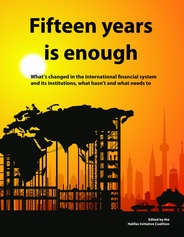
What’s changed in the international financial system and its institutions, what hasn’t and what needs to
Executive Summary
Back in 1995, the G7 met in Halifax during a “time of change and opportunity.” The meeting took place in a context of mounting deficits and debt crises in countries in the South; in the wake of economic collapse in Mexico; and amid strong global criticism from civil society, the media and governments about the World Bank and International Monetary Fund’s (IMF) austere neo-liberal structural adjustment policies.
A lot has changed since then, partly in response to the Halifax G7 Summit and subsequent G7 and G8 meetings. Too many of these improvements, however, exist only on paper. Beyond the surface, the neo-liberal, market-oriented bias that guides the Bank and Fund’s agenda and thinking has not altered.
The 2010 G8 Summit in Toronto in 2010 takes place during another “time of change and opportunity.” The financial crisis has spurred many civil society organizations (CSOs) to insist on far-reaching changes to the global financial system and its institutions. Clearly, as this publication will illustrate, 15 years of refusing to deal with the manifest shortcomings of the global economic system is enough.
Three ways to pay for aid commitments
EMBASSY – Canada’s Foreign Policy Newspaper
Wednesday, February 3, 2010
Stephen Harper’s announcement that child and maternal health will be the signature theme of June’s G8 meeting is certainly timely.
Every day 1,400 women die of pregnancy-related causes. Every day 24,000 children under the age of five die of what are largely preventable causes. Progress on improving child and maternal health is the furthest off-track of the eight Millennium Development Goals (MDGs) UN member states committed to in 2000. This focus gives MDGs four and five, on child and maternal health, the push they need ahead of September’s United Nations High Level Meeting and ten year review of the MDGs.
But funding the initiative comes during difficult days – a global crisis and a budget deficit. Resources are tight.
November 11, 2009
Dominique Strauss-Kahn
Managing Director
International Monetary Fund,
700 19th Street, N.W.,
Washington, D.C. 20431
Dear Mr. Strauss-Kahn:
Re: Request for civil society participation in IMF study on how the financial sector can help pay for the bailouts
In September, the Group of 20 (G20), at their summit in Pittsburgh, mandated the International Monetary Fund (IMF) with preparing a report ahead of the next G20 summit in June 2010 to consider “how the financial sector could make a fair and substantial contribution toward paying for any burdens associated with government interventions to repair the banking system.”
Governance and institution - Global economic governance in crisis: new players, new power
Moderator: Gordon Betcherman, Professor, School of International Development and Global Studies, University of Ottawa
You are missing some Flash content that should appear here! Perhaps your browser cannot display it, or maybe it did not initialize correctly.
Rules and policies - Raising and retaining funds
Moderator: Teresa Healy, Senior Researcher, Social and Economic Policy
Department, Canadian Labour Congress
You are missing some Flash content that should appear here! Perhaps your browser cannot display it, or maybe it did not initialize correctly.
Rules and policies - Raising and retaining funds
Questions and answers and discussion
You are missing some Flash content that should appear here! Perhaps your browser cannot display it, or maybe it did not initialize correctly.