Monthly Issue Update - January 31, 2012
Energy poverty, climate change and the World Bank; Durban postmortem.
Energy poverty, climate change and the World Bank; Durban postmortem.
Transparency and the international economy; Cannes G20 postmortem; export credit agencies fail on human rights.
Selecting new IMF boss; CSOs urge UN to move beyond Ruggie; Argentine civil society sues Barrick Gold; Quebec court accepts jurisdiction in case against Anvil Mining.
 |
Final script May 22, 2010; release date June 18, 2010. |
http://www.embassymag.ca/page/view/tax-06-09-2010
Financial transaction tax is no bank tax
By Fraser Reilly-King
Published June 9, 2010
Big banks can finally breathe a sigh of relief.
This past weekend, Canadian Finance Minister Jim Flaherty managed to rally China, Brazil and South Korea behind him at G20 meetings in Busan, South Korea, and put those pesky discussions about a global bank tax to rest.
Instead of discussing a bank tax at this month's summit, the G20 agreed to "develop principles reflecting the need to protect taxpayers, reduce risks from the financial system, protect the flow of credit in good times and bad, taking into account individual country's circumstances and options."
2010 G8/G20 Canadian Civil Society Coordinating Committee
Parliamentary Roundtables on the G8/G20 Agendas
Monday, April 26th, 2010 5:00 pm - 7:00 pm Room 2-2, National Press Building, 165 Sparks Street, Ottawa
2010 G8/G20 Canadian Civil Society Coordinating Committee
Parliamentary Roundtables on the G8/G20 Agendas
Tuesday, April 27th, 2010 9:00 am - 11:00 am Room 2-2, National Press Building, 165 Sparks Street, Ottawa
2010 G8/G20 Canadian Civil Society Coordinating Committee
Parliamentary Roundtables on the G8/G20 Agendas
Tuesday, April 27th, 2010
9:00 am - 11:00 am
Room 2-2, National Press Building, 165 Sparks Street, Ottawa
In the wake of the financial crisis, countries around the world have cut back on their commitments to combat climate change and poverty. As the G8/G20 leaders prepare to gather in June, what are the challenges and opportunities for getting these issues back on the table?
Presenters:
Charles Abugre, Director of Campaigns for the Millennium Development Goals, United Nations Development Program
Gauri Sreenivasan, Policy Coordinator, Canadian Council for International Co-operation
Wednesday, April 28th 7:00pm - 9:00pm
The University of Ottawa - Pavillion Desmarais
55 Laurier East, Room 1120 (First Floor)
For more information please contact Caroline Foster at cfoster@kairoscanada.org
Co-sponsored by:
Canadian Council for International Co-operation - Africa Canada Forum
Halifax Initiative
KAIROS: Canadian Ecumenical Justice Initiatives
School of International Development and Global Studies
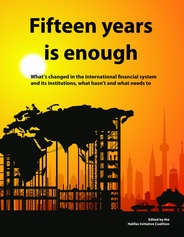 What’s changed in the international financial system and its institutions, what hasn’t and what needs to
Executive Summary
Back in 1995, the G7 met in Halifax during a “time of change and opportunity.” The meeting took place in a context of mounting deficits and debt crises in countries in the South; in the wake of economic collapse in Mexico; and amid strong global criticism from civil society, the media and governments about the World Bank and International Monetary Fund’s (IMF) austere neo-liberal structural adjustment policies.
A lot has changed since then, partly in response to the Halifax G7 Summit and subsequent G7 and G8 meetings. Too many of these improvements, however, exist only on paper. Beyond the surface, the neo-liberal, market-oriented bias that guides the Bank and Fund’s agenda and thinking has not altered.
The 2010 G8 Summit in Toronto in 2010 takes place during another “time of change and opportunity.” The financial crisis has spurred many civil society organizations (CSOs) to insist on far-reaching changes to the global financial system and its institutions. Clearly, as this publication will illustrate, 15 years of refusing to deal with the manifest shortcomings of the global economic system is enough.

