Languages
Search
Newswire on the IFIs
- At sustainability congress, dam builder bars civil society from dialogue
- Austerity a moral issue as it inflicts millions
- World Bank compliance arm assessing fresh complaint against Vizhinjam port
- With Inga dams, donors set to repeat past failures
- Bangladesh exposes flaws in World Bank's Doing Business Index
- Poverty should not be entrusted to economists
Regional Development Banks
This page links to information concerning a number of projects on which we have worked, in solidarity with local communities. In some cases, the projects rely on World Bank funding. In others they involve Canadian companies that may be seeking, or have secured, financial support from Export Development Canada (EDC). Sometimes they involve both. Regardless of the source of funding, in all cases, communities have contacted us because they are concerned about the significant adverse environmental, social and human rights impacts of the projects.
The UN Working Group on Business and Human Rights held its first forum on December 4 and 5 in Geneva. The Halifax Initiative spoke at the forum on a panel concerning public financial institutions and human rights. ECA-Watch, CIEL and BankTrack disseminated the attached document at the forum containing analysis and recommendations regarding financial institutons and human rights.
The debt edition featuring articles on the re-emerging debt crisis, odious debt, debt distress assessments, export credit agencies and soveriegn debt work-out procedures.
Bridge to South KoreaHeld in Toronto, on Monday and Tuesday, June 21-22, 2010, just ahead of the G8 Summit in Huntsville and the G20 Summit in Toronto, this meeting was intended as a strategy session for civil society organizations, platforms and networks from many G20 countries (and beyond) to discuss diverse perspectives on both the G20 as an institution and priorities with respect to its agenda. As the outcome of an initial G20 strategy meeting in Washington DC in April of 2010 among various groups, the intention of this broader meeting of national, regional and international networks was three-fold:
|
MEETING DETAILS
|
Bridge to South KoreaHeld in Toronto, on Monday and Tuesday, June 21-22, 2010, just ahead of the G8 Summit in Huntsville and the G20 Summit in Toronto, this meeting was intended as a strategy session for civil society organizations, platforms and networks from many G20 countries (and beyond) to discuss diverse perspectives on both the G20 as an institution and priorities with respect to its agenda. As the outcome of an initial G20 strategy meeting in Washington DC in April of 2010 among various groups, the intention of this broader meeting of national, regional and international networks was three-fold:
|
MEETING DETAILS
|
2010 G8/G20 Canadian Civil Society Coordinating Committee
Parliamentary Roundtables on the G8/G20 Agendas
Roundtable 2: The Global Financial Crisis
Monday, April 26th, 2010 5:00 pm - 7:00 pm Room 2-2, National Press Building, 165 Sparks Street, Ottawa
You are missing some Flash content that should appear here! Perhaps your browser cannot display it, or maybe it did not initialize correctly.
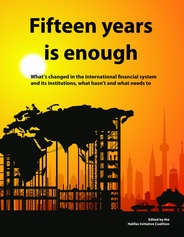
What’s changed in the international financial system and its institutions, what hasn’t and what needs to
Executive Summary
Back in 1995, the G7 met in Halifax during a “time of change and opportunity.” The meeting took place in a context of mounting deficits and debt crises in countries in the South; in the wake of economic collapse in Mexico; and amid strong global criticism from civil society, the media and governments about the World Bank and International Monetary Fund’s (IMF) austere neo-liberal structural adjustment policies.
A lot has changed since then, partly in response to the Halifax G7 Summit and subsequent G7 and G8 meetings. Too many of these improvements, however, exist only on paper. Beyond the surface, the neo-liberal, market-oriented bias that guides the Bank and Fund’s agenda and thinking has not altered.
The 2010 G8 Summit in Toronto in 2010 takes place during another “time of change and opportunity.” The financial crisis has spurred many civil society organizations (CSOs) to insist on far-reaching changes to the global financial system and its institutions. Clearly, as this publication will illustrate, 15 years of refusing to deal with the manifest shortcomings of the global economic system is enough.
| Hon. James Flaherty Minister of Finance Department of Finance Canada 140 O’Connor Street Ottawa, ON K1A 0G5 |
Hon. Lawrence Cannon Minister of Foreign Affairs Foreign Affairs and International Trade Canada 125 Sussex Drive Ottawa, ON K1A 0G2 |
1st February 2010
Ref: Immediate debt cancellation for Haiti
Dear Ministers Flaherty and Cannon,
We are writing to commend the government’s efforts to date to mobilise emergency assistance for disaster relief in Haiti and for speaking to the urgency and importance of debt cancellation for the country. The call to cancel Haiti’s remaining multilateral debt, including last week’s highly concessional $102 million loan from the IMF, benefits from a strong Canadian voice. We urge you to keep demonstrating such leadership in the government’s interventions at the Bretton Woods Institutions, and at Haiti’s largest multilateral creditor, the Inter-American Development Bank (IDB).
CSOs push for Common Approaches revamp
Members of the Organisation for Economic Co-operation and Development (OECD) are currently reviewing a 2007 Council Recommendation regarding export credit agency (ECA) operations. The Recommendation on Common Approaches on the Environment and Officially Supported Export Credits (Common Approaches) is a “gentlemen’s agreement” that seeks to establish a level playing field regarding ECA environmental practice. CSOs argue that the Recommendation’s impact is undermined by the lack of effective accountability mechanisms to ensure consistent and effective application by member governments.
Governance and institution - Global economic governance in crisis: new players, new power
Moderator: Gordon Betcherman, Professor, School of International Development and Global Studies, University of Ottawa
You are missing some Flash content that should appear here! Perhaps your browser cannot display it, or maybe it did not initialize correctly.
Rules and policies - Raising and retaining funds
Moderator: Teresa Healy, Senior Researcher, Social and Economic Policy
Department, Canadian Labour Congress
You are missing some Flash content that should appear here! Perhaps your browser cannot display it, or maybe it did not initialize correctly.
