• about us
  • institutions
  • issues
  • resources
  • publications
  • contact us
Home

Languages

  • English
  • Français

Search

Newswire on the IFIs

  • What more evidence does the World Bank need that carbon markets are not working?
  • At sustainability congress, dam builder bars civil society from dialogue
  • Austerity a moral issue as it inflicts millions
  • World Bank compliance arm assessing fresh complaint against Vizhinjam port
  • With Inga dams, donors set to repeat past failures
  • Bangladesh exposes flaws in World Bank's Doing Business Index
more


Donations

Capital flight and financial regulation

Tightening the leash on multi-national tax dodgers

In this Op Ed, Peter Gillespie of Halifax Initiative notes how multi-national companies have employed artificial accounting methods to avoid paying taxes in the places where they do business.  This problem is affecting developed and developing countries alike.

  • Read more

Tax evasion expert on CBC Power and Politics - October 30, 2012

James Henry, former chief economist at McKinsey and Co., is an international expert on capital flight, tax havens, debt and corporate taxation. Mr. Henry spoke to Evan Solomon on CBC's Power and Politics regarding tax evasion in Canada.

  • Read more

Issue Update - April 30, 2012

The tax edition: the fair tax summit, mobilizing domestic resources and the financial secrecy index. Plus Pascua Lama and Talisman.

  • Read more
  • 1 attachment

Monthly Issue Update - November 30, 2011

Transparency and the international economy; Cannes G20 postmortem; export credit agencies fail on human rights.

  • Read more
  • 1 attachment

Return of the financial transactions tax - Op-ed

Return of the financial transactions tax

Embassy Magazine, Feb. 16, 2011

By John Jacobs

In spite of Canada's attempt to bury it at the Toronto G20 meeting, a tax on financial transactions is back on the global agenda and gaining momentum.

French President Nicolas Sarkozy has pledged to use his term as chair of the G20 to reform the global financial system and curb the speculation that contributed to the economic crisis. At the top of his agenda is an international financial transactions tax (FTT) to fund the fight against poverty and climate change.

  • Read more

Press Responses: June 9, 2010

http://www.embassymag.ca/page/view/tax-06-09-2010

Financial transaction tax is no bank tax

By Fraser Reilly-King
Published June 9, 2010
   
Big banks can finally breathe a sigh of relief.

This past weekend, Canadian Finance Minister Jim Flaherty managed to rally China, Brazil and South Korea behind him at G20 meetings in Busan, South Korea, and put those pesky discussions about a global bank tax to rest.

Instead of discussing a bank tax at this month's summit, the G20 agreed to "develop principles reflecting the need to protect taxpayers, reduce risks from the financial system, protect the flow of credit in good times and bad, taking into account individual country's circumstances and options."

  • Read more

Monthly Issue Update - April 30, 2010

IMF, European Union look to bail out Greece
Greece’s debt crisis is finally coming to a head, with International Monetary Fund (IMF) loans to deal with the country’s deficit and heavy debt load being hammered out in Athens. The European Union and the IMF are negotiating the terms of a bailout as fears mount that Greece’s crisis could soon spread to other countries in Europe and beyond. Other nations carrying significant debt loads, including the United States, are concerned that the Greek crisis is a harbinger of things to come, closer to home.

  • Read more
  • 1 attachment

Policy Brief: The Financial Transaction Tax (FTT) - An idea whose time has come - April 2010

Introduction
A growing number of politicians, civil society organizations, economists and some financiers have become strong advocates of a global Financial Transactions Tax (FTT). An FTT is a tiny tax on financial market transactions such as equity, bond, derivative or foreign exchange trades.

Political leaders, including the presidents of France and Germany and the prime minister of Britain, back an FTT as one of the best ways to fund programs to fight world poverty, pay for climate mitigation and adaptation costs and make financial institutions pay their fair share of the costs of the global crisis which, in large part, was created by their practices. Prominent economists advocate a Financial Transactions Tax as one way to cool down excessive speculation in financial markets, a principal cause of the economic crisis.

  • Read more
  • 1 attachment

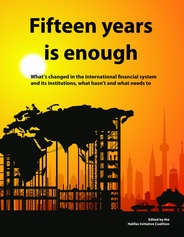
Fifteen years is enough - March 2010

Fifteen years is enoughWhat’s changed in the international financial system and its institutions, what hasn’t and what needs to

Executive Summary
Back in 1995, the G7 met in Halifax during a “time of change and opportunity.” The meeting took place in a context of mounting deficits and debt crises in countries in the South; in the wake of economic collapse in Mexico; and amid strong global criticism from civil society, the media and governments about the World Bank and International Monetary Fund’s (IMF) austere neo-liberal structural adjustment policies.

A lot has changed since then, partly in response to the Halifax G7 Summit and subsequent G7 and G8 meetings. Too many of these improvements, however, exist only on paper. Beyond the surface, the neo-liberal, market-oriented bias that guides the Bank and Fund’s agenda and thinking has not altered.

The 2010 G8 Summit in Toronto in 2010 takes place during another “time of change and opportunity.” The financial crisis has spurred many civil society organizations (CSOs) to insist on far-reaching changes to the global financial system and its institutions. Clearly, as this publication will illustrate, 15 years of refusing to deal with the manifest shortcomings of the global economic system is enough.

  • Read more
  • 1 attachment

Event: Parliamentary roundtables on the G8/G20 Agendas - April 20, 26 and 27, 2010

Parliamentary Roundtables on the G8/G20 Agendas

2010 is an important and unique moment for Parliamentarians to engage with Canadians on some of the most important global issues facing our planet and our future.  On June 25th, 2010, Canada will play host to leaders from the Group of Eight countries in Muskoka, followed by a meeting of G20 leaders in Toronto on June 26-27.

To date, there has been little discussion among parliamentarians about the themes leading up to the 2010 summits, and Canadian civil society is looking to engage members from all parties in a discussion around some of the issues highlighted in our civil society platform, An Agenda for Global Development: G8/G20 Civil Society Coalition Platform, endorsed by over 60 organizations across the country.  The platform discusses specific, measurable, realistic recommendations to put poverty eradication, economic recovery for all and environmental justice at the centre of the international agenda.

To facilitate the conversation, Canadian civil society is organizing three parliamentary roundtables to discuss party perspectives on climate change, the financial crisis and the millennium development goals (MDGs). The Roundtables will occur as the G20 Finance Ministers meet in Washington, as G8 Development Ministers meet in Halifax and as Canada hosts the Africa Partnership Forum in Toronto.

Roundtable 1: Climate change
When:     Tuesday, April 20th, 2010 - 9:00 am –11:00 am
Where:    Room 2-2, Booth Building, 165 Sparks Street, Ottawa

Roundtable 2: Global financial crisis
When:     Monday, April 26th, 2010 - 5:00 pm –7:00 pm
Where:    Room 2-2, Booth Building, 165 Sparks Street, Ottawa

Roundtable 3: Millennium Development Goals
When:     Tuesday, April 27th, 2010 - 9:00am –11:00am
Where:    Room 2-2, Booth Building, 165 Sparks Street, Ottawa

ROUNDTABLE DETAILS

Canadian G8 G20 Civil Society Platform

Roundtable Agendas

  • Climate change
  • Financial crisis
  • Millennium Development Goals

Moderator, MP and Expert Bios 

  • Roundtable 1
  • Roundtable 2
  • Roundtable 3

Podcasts

  • Roundtable 1
  • Keya Chatterjee's segment
  • Roundtable 2
  • Dean Baker's segment
  • Roundtable 3
  • Charles Abugre's segment

  • Read more
  • 6 attachments
  • 1
  • 2
  • 3
  • 4
  • 5
  • 6
  • next ›
  • last »
Syndicate content

Syndicate content
  • about us
  • institutions
  • issues
  • resources
  • publications
  • contact us