Languages
Search
Newswire on the IFIs
- What more evidence does the World Bank need that carbon markets are not working?
- At sustainability congress, dam builder bars civil society from dialogue
- Austerity a moral issue as it inflicts millions
- World Bank compliance arm assessing fresh complaint against Vizhinjam port
- With Inga dams, donors set to repeat past failures
- Bangladesh exposes flaws in World Bank's Doing Business Index
Below is a list of all of the research and reports issued by the Halifax Initiative Coalition in collaboration with our members, national and international partners.
Feel free to also browse our publications by issue and institution using the search menu.
Article prepared for the 'Global Capital, Global Rights' workshop convened by SFU and UBC. The text discusses civil society efforts in support of Bill C-300, legislation that sought to create accountability mechanisms regarding the provision of government support to Canadian extractive companies that operate overseas.
The North American Congress on Latin America (NACLA) recently devoted an edition of its magazine Report on the Americas to Canadian foreign policy in Latin America. The Canadian edition features an article by HI's Program Officer on Canadian mining investment in the region. The article describes recent efforts to reform domestic policy and law regarding the overseas operations of Canadian extractive companies. It focuses on current initiatives that seek to create accountability mechanisms for several government agencies that facilitate Canadian mining, oil and gas investments in the global South.
To read the article click here.
To access the article in Spanish click here.
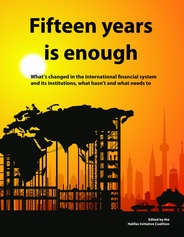
What’s changed in the international financial system and its institutions, what hasn’t and what needs to
Executive Summary
Back in 1995, the G7 met in Halifax during a “time of change and opportunity.” The meeting took place in a context of mounting deficits and debt crises in countries in the South; in the wake of economic collapse in Mexico; and amid strong global criticism from civil society, the media and governments about the World Bank and International Monetary Fund’s (IMF) austere neo-liberal structural adjustment policies.
A lot has changed since then, partly in response to the Halifax G7 Summit and subsequent G7 and G8 meetings. Too many of these improvements, however, exist only on paper. Beyond the surface, the neo-liberal, market-oriented bias that guides the Bank and Fund’s agenda and thinking has not altered.
The 2010 G8 Summit in Toronto in 2010 takes place during another “time of change and opportunity.” The financial crisis has spurred many civil society organizations (CSOs) to insist on far-reaching changes to the global financial system and its institutions. Clearly, as this publication will illustrate, 15 years of refusing to deal with the manifest shortcomings of the global economic system is enough.
Rethinking the international financial system during a time of crisis
Introduction
On October 19 and 20, 2009, the Halifax Initiative held a conference, co-hosted by The North South Institute, the University of Ottawa and the School of International Development and Global Studies (SIDGS), entitled "What’s Missing in the Response to the Global Financial Crisis?" The meeting brought together experts from a range of backgrounds to analyze the challenges facing the global economy, discuss the ways in which the international community has responded to the current financial crisis, and identify shortcomings in these responses.
In 2000, the Halifax Initiative Coalition organized a conference on Transforming the Global Financial System. At that time, the prospect of alternative institutions and mechanisms to the Bretton Woods Institutions (BWIs), for funding international development, were very much a matter of theoretical debate.
Now, just seven years later, the landscape has changed dramatically. There are now new players in the field in the form of alternative institutions, such as the Bank of the South and the Chiang Mai initiative. There are alternative sources of development funding, for example through new bi-lateral donors from China, Brazil and India, or from private sources, such as the Bill Gates Foundation. There are alternative mechanisms for financing development and regulating financial flows, such as airline levies, advance market commitments and currency transaction taxes.
Click here for PDF | here for Word
The Canadian Government, the World Bank and the International Monetary Fund:
A REPORT CARD on FINANCE CANADA’S 2007 ANNUAL REPORT to PARLIAMENT
Executive Summary
Every year at the end of March, the Minister of Finance tables the “Report on Operations under the Bretton Woods and Related Agreements Act”. The Bretton Woods Conference in 1944 established the World Bank and International Monetary Fund (IMF). The annual report details Canadian priorities, commitments and interests over the past fiscal year at these institutions. The annual report to Parliament is an important tool for assessing the government’s actions within these institutions relative to its foreign policy and development objectives, and for informing Parliament and the Canadian public about Canadian priorities at these important multilateral fora. Canada is among a number of countries that report to Parliament on their activities at these institutions.
This paper examines international human rights law and officially-supported export credit agencies. It argues that under international law, specifically the principles of ‘state responsibility,’ the acts and omissions of export credit agencies are attributable to their states. States are therefore responsible under international law for the operations of their export credit agencies, including any ‘wrongful acts’ that these agencies may commit. Such wrongful acts may include violations of the state’s international human rights obligations. The paper argues that state obligations under international law are not currently being met in the provision of officially-supported export credit and investment insurance services. Moreover, the paper argues that through the operations of their export credit agencies, home states can be found complicit in the human rights violations of host governments.
![]() |
A new CNCA web site and publication that documents, with case studies, the eight ways the Federal Government supports Canadian mining, oil and gas companies abroad. The Halifax Initiative was a contributing author to the publication.
|
PDF of full Report Card available here | Microsoft word available here
The Canadian Government, the World Bank and the International Monetary Fund:
A REPORT CARD on FINANCE CANADA’S 2006 ANNUAL REPORT to PARLIAMENT
Introduction
Every year at the end of March, the Minister of Finance tables the “Report on Operations under the Bretton Woods and Related Agreements Act”. The Bretton Woods Conference in 1944 established the World Bank and International Monetary Fund (IMF), and this report details Canadian priorities, commitments and interests over the past fiscal year at these institutions. The annual reports to Parliament are important tools for assessing the government’s actions within these institutions relative to its foreign policy and development objectives, and for informing Parliament and the Canadian public about Canadian priorities at these important multilateral fora. Canada is among a number of countries that report to Parliament on their activities at these institutions.
Click here for complete paper in pdf
Prepared by Özgür Can and Sara Seck, for the ECA-Watch, Halifax Initiative Coalition and ESCR-Net
INTRODUCTION
International human rights law has traditionally focused on establishing the obligations owed by states to individuals. Much recent attention has been given to the question of whether non-state actors, such as transnational corporations, can be considered subjects of international law and as such duty bearers of international human rights obligations. However, less attention has been given to the equally significant question of whether financiers of transnational corporate activities have an obligation to ensure that the activities they support comply with international human rights norms. This paper will explore the international human rights obligations of one type of financial institution: officially supported export credit and investment insurance agencies (Export Credit Agencies or ECAs). ECAs are primarily public or publicly mandated institutions that support and subsidise national trade and investment activities, particularly in developing and emerging markets.
PDF of Full Report available here
Nous regrettons qu'en 2006, l'initiative d'Halifax n'a pas produit de version Francaise.
Report Card on the Canadian Department of Finance “2005 Report on Operations Under Bretton Woods and Related Agreements Act”
Introduction
Every year at the end of March,[1] the Department of Finance tables its report on the operations of the Bretton Woods Institutions (BWI) [2] before Parliament and details activities at these institutions in relation to Canadian priorities, commitments and interests. The reports provide some good background information on the institutions themselves, on emerging issues and challenges within the World Bank and International Monetary Fund (IMF), and some brief details on Canadian priorities and financial participation at these institutions.
This analysis of the International Finance Corporation's (IFC) Sustainability Policy, Performance Standards and Disclosure Policy provides a brief overview of each policy and standard, where it goes beyond the previous safeguard policies, where it falls short, and what is missing in terms of addressing the extractives industries.
These two studies look at the role of the World Bank and the IMF in two poor, heavily indebted countries from a perspective of country ownership. Both found that excessive control of the IFIs of the direction, scope and timing of economic reform and poverty reduction programs led to a low level of country ownership and poor program results.
For pdf: Driving Under the Influence: Senegal's PRSP Process
For pdf: Guyana: Experience of Economic Reform under World Bank and IMF Direction
Internal Review Slams World Bank over Lapses at Guatemala Mine - Backgrounder
August 22, 2005
A forthcoming report by the Compliance Advisor Ombudsman (CAO), a body responsible for conducting internal reviews at the World Bank’s private sector lending arm, the International Finance Corporation (IFC), identifies glaring deficiencies in the due diligence the institution conducted for a controversial new gold-mining project in Guatemala. The project, currently under construction by Canadian company Glamis Gold in Guatemala’s indigenous western highlands, has been surrounded by controversy and conflict since before the IFC approved $45 million in support for the project in June 2004. In January of this year, a forty-day protest by local villagers worried about the mine’s potential environmental impacts ended in bloodshed as security forces clashed with protesters, resulting in one death and dozens of injuries.
Full Report PDF
Summary Analysis of the June 11, 2005 G8 Debt Proposal
On June 11, Finance Ministers from the G8 countries announced a debt remission proposal that would cancel multilateral debts owed to the World Bank, the International Monetary Fund (IMF) and the African Development Bank's African Development Fund (AfDF) by 18 low-income countries.
The G8 proposal offers 100% debt stock cancellation for debts owed to three multilateral financial institutions for the 18 countries that have reached their 'completion points' through the Heavily Indebted Poor Country (HIPC) Initiative. A further 9 HIPC 'decision point' countries, who have not completed or have stalled in their World Bank/IMF programs, might qualify in the near term. The deal could also potentially be extended to the 11 remaining HIPCs that have not yet reached their decision points.
The World Bank and Extractive Industries - The Divisive 'Demonstration Impact' of the Marlin Mine
A case study on Glamis Gold's Marlin Mine prepared by the Halifax Initiative Coalition (June 2005)
For the PDF in English click here
Pour le PDF en francais cliquez ici
PDF of Full Report available here
Version Francaise PDF
Executive Summary
At the end of March annually, the Department of Finance releases its report to Parliament on the operations of the Bretton Woods institutions[1] and their relationship to Canadian priorities, commitments and interests. Canada is one of only a handful of countries that report to their legislative bodies on its activities at these institutions.
The 2004 report provides some good background information on the history, mandate and operations of the institutions. It falls short, however, of providing the qualitative and quantitative information necessary to provide Canadians with an adequate picture of Canada's relations with them. As this report is, effectively, the only means by which Parliament and the public is officially informed of Canada's relations with these institutions, the lack of information creates a serious gap in public accountability and awareness.
Issued to coincide with the Auditor General's review of EDC's environmental policy, this Report Card grades EDC on the progress they have made over the past two years in implementing their disclosure, environment and compliance policies. The Report Card acknowledges the improvements that EDC has made on the environment, but flunks the Crown Corporation on transparency.
Executive Summary available here in pdf
Full Report available here in pdf
Halifax Initiative's new paper, "Who's Minding the Store? Legislator Oversight of the Bretton Woods Institutions" examines to what extent national legislatures maintain democratic oversight of the World Bank and IMF. The survey reveals that legislators are inadequately aware, unevenly informed and largely not consulted on issues related to the institutions. The democratic link to bind citizens and institutional decision-makers is therefore fragile, at best.
Executive Summary available here in pdf
Full Report available here in pdf
The Halifax Initiative Coalition and the Canadian Council for International Co-operation have co-authored the report "At the Table or in the Kitchen: CIDA's New Aid Strategies, Developing Country Ownership and Donor Conditionality," which seeks to understand the implications of three converging elements in CIDA's implementation of its 2002 policy the agency's reliance on PRSPs to define country priorities for poverty reduction, its support for program based approaches to deliver increasing aid budgets for poverty reduction, and its increased coordination with the World Bank and other major donors in these PBAs.
Click here for pdf of the full report
By Asad Ismi
The World Bank and the International Monetary Fund (IMF) are the two most powerful institutions in global trade and finance. Since 1980, the United States government which dominates both bodies has used them to economically subjugate the developing world. The World Bank and the IMF have forced Third World countries to open their economies to Western penetration and increase exports of primary goods to wealthy nations. These steps amongst others have multiplied profits for Western multinational corporations while subjecting Third World countries to horrendous levels of poverty, unemployment, malnutrition, illiteracy and economic decline. The region worst affected has been Africa.

For pdf click here
A Multistakeholder meeting on "Risk, Responsibility and Human Rights: Assessing the Human Rights Impacts of Trade and Project Finance" was organized by the NGO Working Group on EDC in May 2004. A Discussion paper was prepared for the meeting looking at how ECAs and other International Finance Institutions take (or don't take) human rights into account. It made a number of suggestions as to how to mainstream human rights into the project cycle, including a proposal for a human rights impact assessment, and commensurate mechanisms within IFIs.
The Final Report provides the minutes from the meeting, including the presentations made by various speakers, discussion sessions, and a summary of the two day event.
Un aperçu général des présentations faites par divers conférenciers et du contenu des séances de discussion est disponible en français, de même qu’un résumé des conclusions du colloque.
October 27, 2003
Mr. A. Ian Gillespie
President and CEO
Export Development Canada
151 O’Connor street,
Ottawa, ON K1A 1K3
The Hon. Pierre Pettigrew
Minister of International Trade
Department of Foreign Affairs and International Trade
125 Sussex Drive, Tower B, 5th Floor
Ottawa, ON K1A 0G2
Re.: Draft OECD recommendation on Common Approaches on Environment and Officially Supported Export Credits: 2003 Review – Revised version 1
Dear Mr. Gillespie and Minister Pettigrew:
Thank you for giving us this opportunity to comment on the ‘Common Approaches on Environment and Officially Supported Export Credits: 2003 Review – Revised version 1’ (Rev. 1).
Where the Heavily Indebted Poor Country (HIPC) Initiative for debt cancellation is failing.
The HIPC Initiative debt relief program does not achieve its main objective: a permanent exit from the burden of debt. The international community's main debt relief effort has serious problems in too many important aspects:
![]() |
The “Private Interests vs. Public Goods” tour aims to bring Southern activists working on privatization issues at the local or national level to share their stories and strategies with Canadians facing the privatization of health care, education, energy, water and other public services.
Get a copy of "Empty Promises - The IMF, the World Bank, and the Planned Failures of Global Capitalism", which includes over 30 brief articles detailing everything you wanted to know about these two institutions. For press articles resulting from the tour go to the Media button on the navigation bar, to Press Responses to Structural Adjustment. |
Click here for pdf
Significantly destructive projects that violate host country law, international environmental standards and international human rights and labor laws continue to be considered and supported by ECAs. "Race to the Bottom, Take II: An Assessment of Sustainable Development Achievements of ECA-Supported Projects Two Years After OECD Common Approaches Rev 6" presents a civil society proposal for reforming the OECD Common Approaches on Environment and supports the proposal with nine case studies of ECA-backed projects from all over the world.
The projects include the Aracruz Pulp and Paper Factory in Brazil, the BTC pipeline in Azerbaijan, Georgia and Turkey, the Bujagili dam in Uganda, the Camisea oil and gas project in Peru, the Cernavoda 2 Nuclear Reactor in Romania, the Sakhalin II oil and gas project in the Russian Far East, the Sepon Gold and Copper mine in Lao, the Tehri dam in India.
The IMF, World Bank, and the Planned Failures of Global Capitalism - edited by The 50 Years is Enough Network (Book - July 2003)
This book provides an introduction to a wide range of issues on the World Bank and IMF, including on the institutions themselves, and privatization, trade, land reform, microcredit and debt. The Halifax Initiative was one of many organizations to contribute to the book.
Suggested price: $6.00 minimum including postage.
Mail us a cheque made out to Halifax Initiative and we'll mail you a copy.
Halifax Initiative
153 rue Chapel St., Suite 104,
Ottawa, ON K1N 1H5
CANADA
"The G8, Globalization and Human Security - a Resource Package and Facilitator's Guide"
This package uses the lens of the G8 through which to examine issues of globalization and human security because of the central role the G8 plays in economics and global governance. This package was produced by the Alberta Council for Global Cooperation with the support of the Halifax Initiative Coalition.
Revised - June 18 2003
Structural Adjustment in Canada
Most Canadians would be surprised to learn that economists from the International Monetary Fund (IMF) annually visit Canada to dispense advice. We tend to think of the IMF as an institution that prescribes strong medicine, known as Structural Adjustment Programs (SAPs), only to less developed countries. In fact our governments regularly follow the same bitter prescriptions.
In 1990 Prime Minister Brian Mulroney boldly declared that Canada needed to undergo structural adjustment which he promised to deliver through free trade agreements with the US and Mexico and harsh spending cuts. Little changed when the Liberals came to power. Much of the content of Finance Minister Paul Martin’s crucial 1995 budget that slashed our social safety net followed directives that came straight from the IMF.
Review of "Damming Evidence: Canada and the World Commission on Dams," by the NGO Working Group on Export Development Canada, a project of the Halifax Initiative.
The last sentence of this new report sums up the authors' position well: "Canada has led in the promotion of hydroelectricity worldwide. It must now lead in the implementation of the World Commission on Dams."
Click here for pdf
The World Bank and the IMF have used their considerable power to force countries to privatize natural and public resources. This report documents some of the impacts, ranging from reduced access to essential services, loss of jobs and increased corruption.
Going Beyond the HIPC Initiative: Another Pathway to Achieving Freedom from the Burden of Debt
Problems with the HIPC Initiative
The need to find another approach to the Third World debt problem has become more apparent in the time since the World Bank and the International Monetary Fund (IMF) launched their program of debt relief for the Heavily Indebted Poor Countries (HIPCs). This program, the HIPC Initiative, has been generally criticized for providing too little for too few countries, over too long a time period.
More specifically, the criticisms have been focused on:
The time period. Completion of the debt relief process could take years, the model being six years of successful completion of structural adjustment requirements. This is widely viewed as a serious weakness of the problem given the urgency of the situation for people in the poor countries that have debt problems.
“Addressing Unsustainable and Illegitimate Debt—Strategic Options for Civil Society”
CCIC Boardroom – 3rd floor – 1 Nicholas Street, Ottawa, Ontario
February 26, 2003
Click here for full report in pdf
International debt management since the 1980’s has been characterized by fragmented and inadequate efforts on the part of creditors to restructure or reduce debt, resulting in increasingly unpayable debt burdens in developing countries. A renewed sense of urgency amongst creditors has resulted in calls for new measures, driven by factors including: recurrent financial crises resulting in sovereign default or near default, increasingly large and ineffective official sector “bail outs” of private creditors and the rise in influence of minority creditor and their claims against sovereigns.
The International Monetary Fund’s Sovereign Debt Restructuring Mechanism (SDRM) proposal aims to internationalize insolvency proceedings by creating a mechanism to allow private creditors to negotiate a restructuring arrangement with a debtor government that is insolvent or approaching insolvency. By establishing a framework for debt workout, the proposal is designed “to facilitate the orderly, predictable and rapid restructuring of unsustainable sovereign debt while protecting asset values and creditors rights.” With the SDRM proposal, the IMF is attempting to both “safeguard its resource” and regain international credibility by re-positioning itself in international debt management.
Click here for full report in pdf
This report documents seven projects being pursued by Canadian companies abroad that will have negative environmental, social and human rights impacts. It includes a more detailed critique of EDC's environment and disclosure policies.
Linking Investment and Human Rights: the case of export credit agencies
Click here for full report in pdf
Click here for the Backgrounder for Discussion
This seminar held in London, England, in December 2002, looked at various methodologies for taking human rights into account in investment projects, and determining ways that these can be applied to export credit agencies.
Click here for pdf
"New Report Highlights Environmental Risks of EDC Deal on CANDU Reactor"
This report, commissioned by European NGOs analyzes the existing environmental impact assessment information and finds it deficient.
Click here for pdf
Villagers had already noticed a decline in the agricultural productivity of their land. Although no scientific studies were carried out, the World Bank-financed Kiambere and other up-stream dams are likely responsible for reduced flooding of the river plains. “We will be reduced to beggars if they interfere with our farming,” says a village elder. “We Pokomo have never killed wildlife, but if you beat me because of wildlife, then I will kill the wildlife because it has become my problem.”[57]
Click here for pdf
This report offers a succinct overview of the GEF's first ten years, examining some of its history, structure and governance, the conflicting expectations of its participants and the implications of the central role of the World Bank. Co-released with Environmental Defense (http://www.environmentaldefense.org)
Click here for pdf
This report documents the World Bank's approach to sustainable development in specific sectors addressed in Agenda 21, such as climate change, poverty, forests, pesticides and marine and freshwater resources. Co-released with Friends of the Earth (http://www.foe.org)
Final Report on the G6B (Group of 6 billion) People’s Summit
The Halifax Initiative participated in the G6B People’s Summit. We assisted in bringing to the Summit two Southern activists, with whom we work - Tundu Lissu, a Tanzanian activist with the Lawyers Environmental Action Team, to discuss the impacts of foreign direct investment in mining, and Virginia Setshedi, a South African activist with the Soweto Electricity Crisis Committee. As well, Pam Foster, Coordinator, participated on three panels, presenting on financial liberalization, the environment and the G8.
Click here for the Speech on Financial Liberalization
Conference Papers - Vancouver, October 4-6, 2001
Click here for pdf
Between Oct 4 - 6, 2001, Halifax Initiative hosted a conference "Taxing Currency Transactions - From Feasibility to Implementation" which attracted sixty participants from eighteen countries including: Belgium, Benin, Brazil, Canada, China, Finland, France, Germany, India, Japan, Korea, Mexico, Norway, Philippines, Thailand, United Kingdom, United States, Vietnam and Zimbabwe. The progamme included an evening public forum on Oct 4th attended by over 110 people and the two-day conference.
The UN Multilateral Environmental Agreement /Financial Mechanism
as a Model for Currency Transactions Tax Governance and Revenue Redistribution
Robin Round
Policy Analyst
Halifax Initiative
Vancouver, CANADA
rjround@halifaxinitiative.org
September 2001
In Canada, CASA is being undertaken by a Steering Committee of non-governmental organizations from a number of sectors, including labour, development and anti-poverty organizations. As Canada does not receive structural adjustment loans from international financial institutions, the Steering Committee in Canada chose to focus on the 1995 budget, in which the federal government pushed through many structural adjustment reforms, reforms recommended to Canada by the IMF in its Article IV consultations. A first national forum was held, December, 1998 from which four research areas were chosen:
Click here for pdf
Like the Report Reckless Lending Volume 1, Volume II documents the negative impacts of several projects financed by Canada's Export Development Corporation (EDC). These publications demonstrate clearly the need to ensure that EDC, a public agency, be required by law to uphold public policies and international standards protecting human rights, the environment and the social needs of communities.
In Canada, CASA is being undertaken by a Steering Committee of non-governmental organizations from a number of sectors, including labour, development and anti-poverty organizations. As Canada does not receive structural adjustment loans from international financial institutions, the Steering Committee in Canada chose to focus on the 1995 budget, in which the federal government pushed through many structural adjustment reforms, reforms recommended to Canada by the IMF in its Article IV consultations. A first national forum was held, December, 1998 from which four research areas were chosen:
Click here for pdf
Submitted as part of EDC's consultations on the environment, this report makes a case for placing EDC under the provisions of the Canadian Environmental Assessment Act.
Abstract
Click here for pdf
EDC and Disclosure: Letting the Sun Shine In: A submission to EDC consultations on disclosure, this report makes a case for increasing disclosure and bringing EDC under the Access to Information Act.
Summary of Recommendations for Disclosure:
Hassan Bougrine
Department of Economics
Laurentian University
Sudbury, Ontario
Canada P3E 2G9
email: hassan@nickel.laurentian.ca
phone: 1-705-675-1151, ext. 4265
fax: 1-705-675-4886
* The author is Associate Professor of Economics at Laurentian University and editor of The Economics of Public Spending: Debts, Deficits and Economic Performance, Cheltenham: U.K., Edward Elgar, 2000.
REPORT FROM MEETING WITH NATIONAL FARMERS UNION MEMBERS
Background
Since the mid 1970s the realized net income of Canadian farms have fallen consistently. The farm crisis that dominated headlines a few months ago may have been triggered by environmental conditions but statistical information clearly indicates it is part of an ongoing trend that has seen net income per farm (in 1998 $) fall from $50,000 in 1975 to -$2,000 in 1999. Clearly this is part of an ongoing trend that the AFB must address in dramatic fashion lest we see the complete annihilation of the Canadian family farm and with it, the rural communities on which much of Canada was built.
Click here for full report in pdf
Reckless Lending Volume I documents the negative impacts of several projects financed by Canada's Export Development Corporation (EDC). These publications demonstrate clearly the need to ensure that EDC, a public agency, be required by law to uphold public policies and international standards protecting human rights, the environment and the social needs of communities.
Canada’s Export Development Corporation puts people and the environment in developing countries at risk. The following case studies document some of the negative impacts of EDC-supported projects. Unlike the World Bank and the US Export Credit Agencies, EDC is not required to undertake assessments of the possible impacts on the environment, human rights or communities when, for example, a dam, a nuclear reactor or a mine is being built. The result, as these case studies show, can be disastrous.
Prepared by the NGO Working Group on the Export Development Corporation, a project of the Halifax Initiative
The Canadian Export Development Corporation (EDC) is the main source of publicly supported export financing in Canada, designed to complement the private financial sector wherever possible. A federal Crown corporation, EDC provides Canadian exporters with financing products to help their customers, and with commercial and political risk insurance, particularly for higher-risk and emerging markets. In 1998, EDC worked with 4,183 customers in 200 countries, helping Canadian companies to generate nearly $35 billion in sales and foreign investments.
Click here for pdf
Policy Paper of the NGO Working Group on the Export Development Corporation, November 1999, on issues relating to disclosure, the environment, human rights and debt.
This report makes a series of recommendations, building on EDC's own initiatives and the recommendations made by Gowling, Strathy and Henderson in their report on the legislative review of the Export Development Act. If implemented, EDC would be a public financial institution that we would be proud to call Canadian.
The Tobin-Type Tax - Debunking the Myths
(This article in Spanish is on this link)
Currency transactions taxes such as the Tobin-type tax 1 are often dismissed by critics before all the arguments have been heard. They view the tax as too difficult to adopt and too easy to avoid. Much criticism is ill-informed or designed to stifle debate. Here are the most common myths and our response to them:
A TOBIN-TYPE TAX WILL HIT THE POOR
The tax is a progressive one, designed to target only those profiting from destabilising currency speculation. The poor don't flip millions of dollars a day on currency and bond markets, the world's biggest banks and investment firms do. This tax will hit them.
A Feasible Foreign Exchange Transactions Tax
Rodney Schmidt*
Research Associate
North-South Institute
55 Murray Street, Suite 200
Ottawa, Ontario, Canada
K1N 5M3
Fax: (613) 241-7435
Program Advisor
Vietnam Economic and Environment Management
International Development Research Centre
40 Nguyen Van Ngoc
Hanoi, Vietnam
Fax: (84-4) 766-0469
E-mail: veem@hn.vnn.vn
March 1999
Abstract
In September 1998, Halifax Initiative organized a two-day roundtable on the eve of the Commonwealth Finance Ministers meeting in Ottawa, to discuss solutions to debt and financial crises.
Over 200 people attended an evening public discussion with Susan George, Kavaljit Singh and Kari Polyani Levitt.
Click here for full report pdf
Click here for Press Release – A Six Point Plan to Deal With Global Financial Turmoil
Click below for Final Report (PDF files)
- The Cover (888Kb)
- The Report (133 Kb)
- Panelists (5.0 Mb)
Calling the IFIs to Account: International Financial Institutions in the 21st Century
In October 1997, the Halifax Initiative joined with organizations in Vancouver and Edmonton to host two public roundtables to discuss how the IFIs had responded to the calls for renewal. Over two hundred individuals participated in the discussions.
Introduction
The International Monetary Fund and the World Bank have proposed a framework of action to assist in resolving the debt problems of heavily indebted poor countries. In the current formulation of this framework, replenishment of the Enhanced Structural Adjustment Facility (ESAF) has been presented as the centrepiece of the IMF contribution.
The IMF role was described in the brief prepared by IMF and World Bank staff for the April 23, 1996 meeting of the Development Committee:
"The IMF would also be expected to take action that would reduce the present value of its claims on a country, consistent with broad and equitable participation in the framework of this initiative. Various possibilities involving support under the ESAF which might achieve this objective are currently under examination."
This information was provided to the Halifax Initiative Coalition (the Social Justice Committee is a member) Sept. 30 1999, in response to a request under the Access to Information Act.
SECRET
INTERNATIONAL MONETARY FUND
CANADA
Article IV Consultation Discussions
Statement by the Fund Mission to the Minister of Finance
Ottawa, December 7, 1995


