Canada, the Bank and Fund - Reports and analysis
HI Resource Types:
 Below is a list of all of the research and reports issued by the Halifax Initiative Coalition in collaboration with our members, national and international partners.
Feel free to also browse our publications by issue and institution using the search menu.
Article prepared for the 'Global Capital, Global Rights' workshop convened by SFU and UBC. The text discusses civil society efforts in support of Bill C-300, legislation that sought to create accountability mechanisms regarding the provision of government support to Canadian extractive companies that operate overseas.
The North American Congress on Latin America (NACLA) recently devoted an edition of its magazine Report on the Americas to Canadian foreign policy in Latin America. The Canadian edition features an article by HI's Program Officer on Canadian mining investment in the region. The article describes recent efforts to reform domestic policy and law regarding the overseas operations of Canadian extractive companies. It focuses on current initiatives that seek to create accountability mechanisms for several government agencies that facilitate Canadian mining, oil and gas investments in the global South.
To read the article click here.
To access the article in Spanish click here.
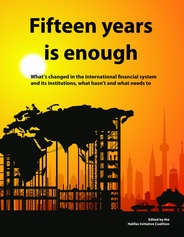 What’s changed in the international financial system and its institutions, what hasn’t and what needs to
Executive Summary
Back in 1995, the G7 met in Halifax during a “time of change and opportunity.” The meeting took place in a context of mounting deficits and debt crises in countries in the South; in the wake of economic collapse in Mexico; and amid strong global criticism from civil society, the media and governments about the World Bank and International Monetary Fund’s (IMF) austere neo-liberal structural adjustment policies.
A lot has changed since then, partly in response to the Halifax G7 Summit and subsequent G7 and G8 meetings. Too many of these improvements, however, exist only on paper. Beyond the surface, the neo-liberal, market-oriented bias that guides the Bank and Fund’s agenda and thinking has not altered.
The 2010 G8 Summit in Toronto in 2010 takes place during another “time of change and opportunity.” The financial crisis has spurred many civil society organizations (CSOs) to insist on far-reaching changes to the global financial system and its institutions. Clearly, as this publication will illustrate, 15 years of refusing to deal with the manifest shortcomings of the global economic system is enough.
Rethinking the international financial system during a time of crisis
Introduction
On October 19 and 20, 2009, the Halifax Initiative held a conference, co-hosted by The North South Institute, the University of Ottawa and the School of International Development and Global Studies (SIDGS), entitled "What’s Missing in the Response to the Global Financial Crisis?" The meeting brought together experts from a range of backgrounds to analyze the challenges facing the global economy, discuss the ways in which the international community has responded to the current financial crisis, and identify shortcomings in these responses.
To access the submission, click here.
In 2000, the Halifax Initiative Coalition organized a conference on Transforming the Global Financial System. At that time, the prospect of alternative institutions and mechanisms to the Bretton Woods Institutions (BWIs), for funding international development, were very much a matter of theoretical debate.
Now, just seven years later, the landscape has changed dramatically. There are now new players in the field in the form of alternative institutions, such as the Bank of the South and the Chiang Mai initiative. There are alternative sources of development funding, for example through new bi-lateral donors from China, Brazil and India, or from private sources, such as the Bill Gates Foundation. There are alternative mechanisms for financing development and regulating financial flows, such as airline levies, advance market commitments and currency transaction taxes.
Click here for PDF | here for Word
Executive Summary
Every year at the end of March, the Minister of Finance tables the “Report on Operations under the Bretton Woods and Related Agreements Act”. The Bretton Woods Conference in 1944 established the World Bank and International Monetary Fund (IMF). The annual report details Canadian priorities, commitments and interests over the past fiscal year at these institutions. The annual report to Parliament is an important tool for assessing the government’s actions within these institutions relative to its foreign policy and development objectives, and for informing Parliament and the Canadian public about Canadian priorities at these important multilateral fora. Canada is among a number of countries that report to Parliament on their activities at these institutions.
This paper examines international human rights law and officially-supported export credit agencies.
