Issue Update - August 31, 2012
The debt edition featuring articles on the re-emerging debt crisis, odious debt, debt distress assessments, export credit agencies and soveriegn debt work-out procedures.
The debt edition featuring articles on the re-emerging debt crisis, odious debt, debt distress assessments, export credit agencies and soveriegn debt work-out procedures.
G8-G20 summits fall flat, ignore call for sustainable future
This month “Fortress Toronto”, with its 18,000 strong security forces and four kilometer chain link fence, bore witness to a Peoples’ Summit ripe with ideas and alternatives, petitions signed by 1.75 million asking leaders to invest in the future now, a 25,000 strong peaceful protest, media stunts galore, some regrettable violence, and two deeply disappointing summits.
 |
Final script May 22, 2010; release date June 18, 2010. |
Bridge to South KoreaHeld in Toronto, on Monday and Tuesday, June 21-22, 2010, just ahead of the G8 Summit in Huntsville and the G20 Summit in Toronto, this meeting was intended as a strategy session for civil society organizations, platforms and networks from many G20 countries (and beyond) to discuss diverse perspectives on both the G20 as an institution and priorities with respect to its agenda. As the outcome of an initial G20 strategy meeting in Washington DC in April of 2010 among various groups, the intention of this broader meeting of national, regional and international networks was three-fold:
|
MEETING DETAILS
|
Bridge to South KoreaHeld in Toronto, on Monday and Tuesday, June 21-22, 2010, just ahead of the G8 Summit in Huntsville and the G20 Summit in Toronto, this meeting was intended as a strategy session for civil society organizations, platforms and networks from many G20 countries (and beyond) to discuss diverse perspectives on both the G20 as an institution and priorities with respect to its agenda. As the outcome of an initial G20 strategy meeting in Washington DC in April of 2010 among various groups, the intention of this broader meeting of national, regional and international networks was three-fold:
|
MEETING DETAILS
|
IMF, European Union look to bail out Greece
Greece’s debt crisis is finally coming to a head, with International Monetary Fund (IMF) loans to deal with the country’s deficit and heavy debt load being hammered out in Athens. The European Union and the IMF are negotiating the terms of a bailout as fears mount that Greece’s crisis could soon spread to other countries in Europe and beyond. Other nations carrying significant debt loads, including the United States, are concerned that the Greek crisis is a harbinger of things to come, closer to home.
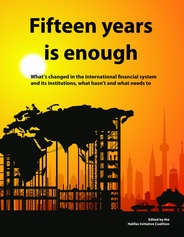 What’s changed in the international financial system and its institutions, what hasn’t and what needs to
Executive Summary
Back in 1995, the G7 met in Halifax during a “time of change and opportunity.” The meeting took place in a context of mounting deficits and debt crises in countries in the South; in the wake of economic collapse in Mexico; and amid strong global criticism from civil society, the media and governments about the World Bank and International Monetary Fund’s (IMF) austere neo-liberal structural adjustment policies.
A lot has changed since then, partly in response to the Halifax G7 Summit and subsequent G7 and G8 meetings. Too many of these improvements, however, exist only on paper. Beyond the surface, the neo-liberal, market-oriented bias that guides the Bank and Fund’s agenda and thinking has not altered.
The 2010 G8 Summit in Toronto in 2010 takes place during another “time of change and opportunity.” The financial crisis has spurred many civil society organizations (CSOs) to insist on far-reaching changes to the global financial system and its institutions. Clearly, as this publication will illustrate, 15 years of refusing to deal with the manifest shortcomings of the global economic system is enough.
Parliamentary Roundtables on the G8/G20 Agendas 2010 is an important and unique moment for Parliamentarians to engage with Canadians on some of the most important global issues facing our planet and our future. On June 25th, 2010, To date, there has been little discussion among parliamentarians about the themes leading up to the 2010 summits, and Canadian civil society is looking to engage members from all parties in a discussion around some of the issues highlighted in our civil society platform, An Agenda for Global Development: G8/G20 Civil Society Coalition Platform, endorsed by over 60 organizations across the country. The platform discusses specific, measurable, realistic recommendations to put poverty eradication, economic recovery for all and environmental justice at the centre of the international agenda. To facilitate the conversation, Canadian civil society is organizing three parliamentary roundtables to discuss party perspectives on climate change, the financial crisis and the millennium development goals (MDGs). The Roundtables will occur as the G20 Finance Ministers meet in Washington, as G8 Development Ministers meet in Halifax and as Canada hosts the Africa Partnership Forum in Toronto. Roundtable 1: Climate change Roundtable 2: Global financial crisis Roundtable 3: Millennium Development Goals |
ROUNDTABLE DETAILS Canadian G8 G20 Civil Society Platform Roundtable Agendas Moderator, MP and Expert Bios Podcasts
|
The corporate responsibilty to respect human rights
Detractors of Private Member’s Bill C-300 (IU February 2009) draw attention to the bill’s treatment of human rights. The bill establishes guidelines for Canadian extractive companies that operate overseas. These guidelines must be met by companies that receive support from Export Development Canada, the Canadian Pension Plan and Canadian embassies. The guidelines are to include provisions based on Canada's international human rights obligations.
Government accountability bill returns to the House
On March 3, the Governor General will open a new session of Parliament, ending the recess created when the Harper government prorogued the previous session in December. All legislation that was under consideration at that time was extinguished, with the exception of private members’ bills, which return to the House, unscathed. These bills begin anew at whichever stage of the legislative process they had reached before the plug was pulled on Parliament.
Rethinking the international financial system during a time of crisis
Introduction
On October 19 and 20, 2009, the Halifax Initiative held a conference, co-hosted by The North South Institute, the University of Ottawa and the School of International Development and Global Studies (SIDGS), entitled "What’s Missing in the Response to the Global Financial Crisis?" The meeting brought together experts from a range of backgrounds to analyze the challenges facing the global economy, discuss the ways in which the international community has responded to the current financial crisis, and identify shortcomings in these responses.

