Languages
Search
Newswire on the IFIs
- At sustainability congress, dam builder bars civil society from dialogue
- Austerity a moral issue as it inflicts millions
- With Inga dams, donors set to repeat past failures
- Bangladesh exposes flaws in World Bank's Doing Business Index
- Poverty should not be entrusted to economists
- A flawed 'Doing Business' report
Organisation for Economic Co-operation and Development
This page links to information concerning a number of projects on which we have worked, in solidarity with local communities. In some cases, the projects rely on World Bank funding. In others they involve Canadian companies that may be seeking, or have secured, financial support from Export Development Canada (EDC). Sometimes they involve both. Regardless of the source of funding, in all cases, communities have contacted us because they are concerned about the significant adverse environmental, social and human rights impacts of the projects.
This month we examine 'odious investment' - Mongolia Undermined; (Mis)Investment in Agriculture; More than Bricks and Mortar; and the Canada Pension Plan Investment Board.
The tax edition: the fair tax summit, mobilizing domestic resources and the financial secrecy index. Plus Pascua Lama and Talisman.
Transparency and the international economy; Cannes G20 postmortem; export credit agencies fail on human rights.
![]() |
Final script May 22, 2010; release date June 18, 2010. |
You are missing some Flash content that should appear here! Perhaps your browser cannot display it, or maybe it did not initialize correctly.
Bridge to South KoreaHeld in Toronto, on Monday and Tuesday, June 21-22, 2010, just ahead of the G8 Summit in Huntsville and the G20 Summit in Toronto, this meeting was intended as a strategy session for civil society organizations, platforms and networks from many G20 countries (and beyond) to discuss diverse perspectives on both the G20 as an institution and priorities with respect to its agenda. As the outcome of an initial G20 strategy meeting in Washington DC in April of 2010 among various groups, the intention of this broader meeting of national, regional and international networks was three-fold:
|
MEETING DETAILS
|
Bridge to South KoreaHeld in Toronto, on Monday and Tuesday, June 21-22, 2010, just ahead of the G8 Summit in Huntsville and the G20 Summit in Toronto, this meeting was intended as a strategy session for civil society organizations, platforms and networks from many G20 countries (and beyond) to discuss diverse perspectives on both the G20 as an institution and priorities with respect to its agenda. As the outcome of an initial G20 strategy meeting in Washington DC in April of 2010 among various groups, the intention of this broader meeting of national, regional and international networks was three-fold:
|
MEETING DETAILS
|
2010 G8/G20 Canadian Civil Society Coordinating Committee
Parliamentary Roundtables on the G8/G20 Agendas
Roundtable 2: The Global Financial Crisis
Monday, April 26th, 2010 5:00 pm - 7:00 pm Room 2-2, National Press Building, 165 Sparks Street, Ottawa
You are missing some Flash content that should appear here! Perhaps your browser cannot display it, or maybe it did not initialize correctly.
2010 G8/G20 Canadian Civil Society Coordinating Committee
Parliamentary Roundtables on the G8/G20 Agendas
Roundtable 2: The Global Financial Crisis
Monday, April 26th, 2010 5:00 pm - 7:00 pm Room 2-2, National Press Building, 165 Sparks Street, Ottawa
You are missing some Flash content that should appear here! Perhaps your browser cannot display it, or maybe it did not initialize correctly.
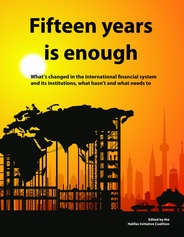
What’s changed in the international financial system and its institutions, what hasn’t and what needs to
Executive Summary
Back in 1995, the G7 met in Halifax during a “time of change and opportunity.” The meeting took place in a context of mounting deficits and debt crises in countries in the South; in the wake of economic collapse in Mexico; and amid strong global criticism from civil society, the media and governments about the World Bank and International Monetary Fund’s (IMF) austere neo-liberal structural adjustment policies.
A lot has changed since then, partly in response to the Halifax G7 Summit and subsequent G7 and G8 meetings. Too many of these improvements, however, exist only on paper. Beyond the surface, the neo-liberal, market-oriented bias that guides the Bank and Fund’s agenda and thinking has not altered.
The 2010 G8 Summit in Toronto in 2010 takes place during another “time of change and opportunity.” The financial crisis has spurred many civil society organizations (CSOs) to insist on far-reaching changes to the global financial system and its institutions. Clearly, as this publication will illustrate, 15 years of refusing to deal with the manifest shortcomings of the global economic system is enough.